
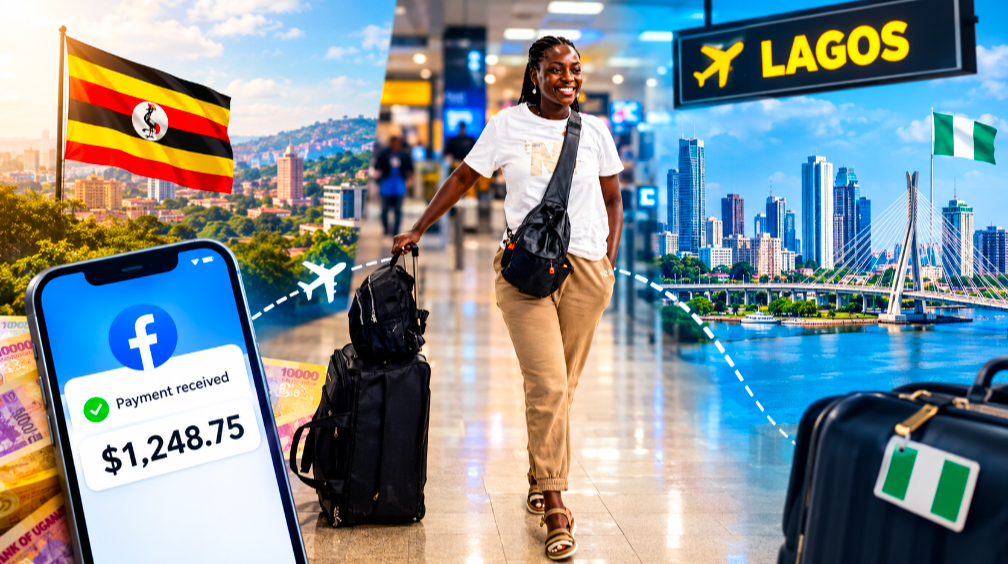
A Ugandan content creator’s Nigeria trip has caught attention online after she shared the story behind it. Gladys, a Kampala-based creator who runs the Facebook page Simpo Gladys Official, which has attracted 1.7 million followers, recently posted a photo from her second visit to Lagos. In the caption, she recounted how her first trip came about: an impulsive flight booking made shortly after she received her first-ever payment from Facebook’s Content Monetization program.
According to her post, the payment came to $2,170 and landed in her account on October 26, 2024. Within what she describes as a single morning, she had decided to book a flight to Lagos, a decision she says she still thinks about today.
The Post That Sparked the Story
In her caption, Gladys described waking up one morning and, on impulse, booking her first flight to Lagos shortly after receiving that initial Facebook payment. She wrote that she “emptied her wallet” to make the trip happen, a choice she frames as spontaneous rather than planned.
She has since posted a fuller account of the experience on her YouTube channel, Simpo Gladys, which has 409,000 subscribers, in a video she referenced in her post. As she put it in her own words, deciding to take that first trip is something she still reflects on. This article draws on what Gladys has voluntarily shared publicly in her original Facebook post and the accompanying YouTube video, though the video’s full contents have not been independently reviewed for this piece beyond what she described in her caption.
What Is Facebook Content Monetization?
Gladys’s story centers on Facebook Content Monetization, a program Meta introduced in beta in October 2024. It combines three previously separate monetization programs, in-stream ads, ads on Reels, and the Performance Bonus, into one unified system covering Reels, longer videos, photos, and text posts.
The program was initially rolled out to a limited group. Its first phase was invitation-only, with Meta sending invites to about one million creators already monetizing on Facebook, and open enrollment was not expected to begin until 2025. Payouts under the program are tied directly to how content performs. Meta has said the payout model mirrors the existing performance-based systems used in its earlier programs, meaning earnings depend on the reach and engagement of eligible content rather than a fixed rate.
The scale of Facebook’s creator payouts gives some sense of why a program like this matters to creators across the continent. The platform paid out more than $2 billion to creators in a single year through videos, reels, photos, and text posts, and by 2025, Meta reported paying out nearly $3 billion to creators, with 60% of that going to Reels content specifically.
It’s worth being clear about what this means and what it doesn’t. Monetization payouts like the one Gladys describes are performance-based and vary widely between creators depending on content reach, audience size, and engagement. Nothing about the program guarantees a specific payout amount, and Meta’s own materials frame it as an earning opportunity tied to content performance, not a fixed income source. Readers considering Facebook monetization should treat any individual’s results, including Gladys’s, as one data point rather than a template. For details on eligibility and how the program works, Meta’s own creator resources page is the most direct source.
From Kampala to Lagos: A Creator’s Impulsive Trip
What stands out in Gladys’s account isn’t the payment itself so much as what she did with it. Rather than saving or reinvesting the funds, she describes using the money to book a spontaneous flight to Lagos, a decision made, by her account, within the same morning she received the payment notification.
She has said she “emptied her wallet” for the trip, framing it as an experience she chose to prioritize over other uses for the money. That framing matters for readers: this is a personal choice she made, not a recommendation, and nothing in her account suggests it as a financial strategy others should replicate.
The trip clearly left an impression. Gladys has since returned to Nigeria for a second visit, and the photo that prompted renewed attention to her story was taken during that follow-up trip. She has also posted a longer narration of her original experience on her Simpo Gladys YouTube channel, though as noted above, this article does not summarize the video’s full contents beyond what she mentioned in her post.

The Rising Trend of African Creators Traveling on Platform Earnings
Gladys’s story fits into a broader pattern of growth in Africa’s creator economy. Industry estimates reported by The Guardian Nigeria place the continent’s creator economy at roughly $3.08 billion in 2023, with projections putting it at $17.84 billion by 2030, driven largely by rising social media use and expanding mobile internet access.
Facebook remains a dominant platform in this landscape. Data compiled by Techpoint Africa shows the platform accounts for the largest share of social media users across the continent, at roughly 74.6%, ahead of Instagram and YouTube, making Meta’s monetization tools relevant to a large pool of creators. At the same time, monetization remains uneven. Reports indicate that more than half of African creators earn less than $62 a month from their content, underscoring how widely individual results vary.
Against that backdrop, stories like Gladys’s, where a single payment funds an international trip, tend to stand out precisely because they aren’t the norm. They’re notable as individual milestones, not as evidence of typical earnings. Part of what draws traveling creators to Nigeria in the first place is the sheer range of experiences on offer, from city life in Lagos to nature-focused destinations such as the country’s best wildlife parks, which regularly feature in itineraries for visiting content creators.
Planning a Return Trip: What’s Next for Gladys
Gladys’s most recent post suggests her relationship with Nigeria isn’t over. She has said she is planning another trip and used her post to ask followers for suggestions on which Nigerian states to visit next.
For creators or travelers weighing where to go next, Nigeria offers plenty beyond Lagos. Benue State, for instance, draws visitors for its festive season attractions, detailed in this guide to the best places to visit in Benue during Christmas. Further south, Cross River State is home to one of the country’s most distinctive natural attractions, covered in this look at the Cross River rainforest and gorilla sanctuary at Afi Mountain, either of which could make a fitting addition to her next itinerary.
Conclusion
Gladys’s Nigeria trip, funded by her first Facebook Content Monetization payment, is a personal story about impulse, opportunity, and a country that left enough of an impression for her to return. It’s also a small window into how platform monetization tools are shaping the choices of creators across Africa, even as payouts and outcomes vary widely from one creator to the next.
Key takeaways:
- Gladys received her first Facebook Content Monetization payment of $2,170 on October 26, 2024, according to her own account.
- She used the payment to book an impulsive flight to Lagos, later documenting the trip on YouTube.
- She has since returned to Nigeria and is planning a third visit.
- Facebook Content Monetization payouts are performance-based and not guaranteed; individual results, including Gladys’s, vary widely and should not be read as financial advice.