

Adedayo Akinwale in Abuja
The United Nations Office on Drugs and Crime (UNODC) has stated that Africa should shut the hole between proof generated on substance use and the selections made by governments, warning that the disconnect has severe coverage and human penalties.
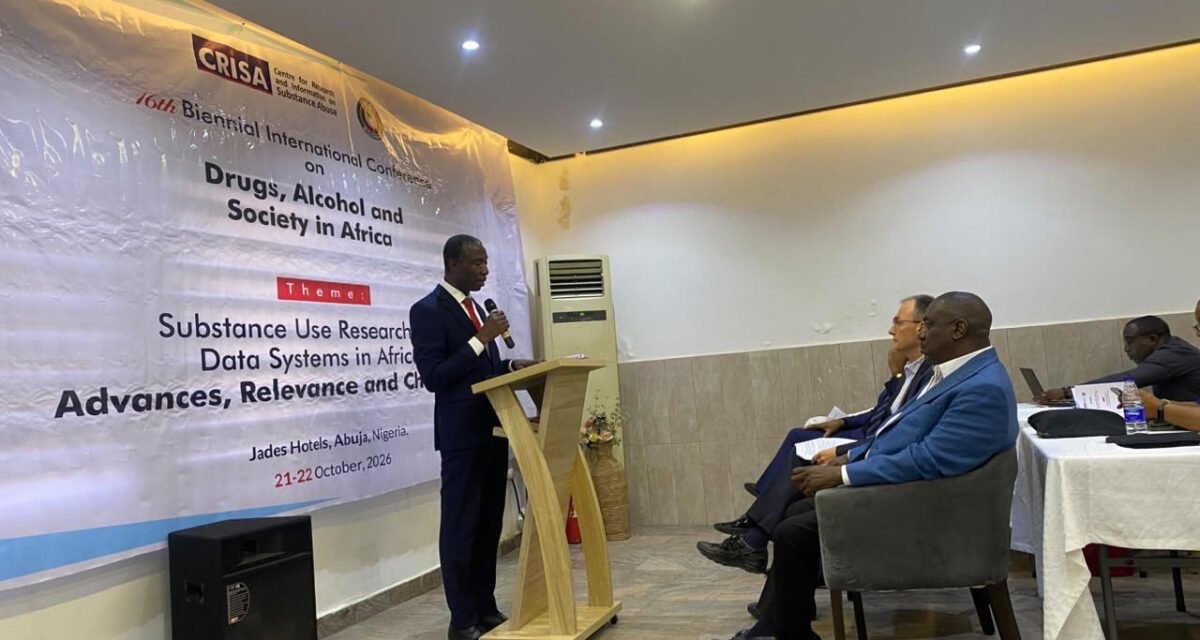
The UNODC Country Representative in Nigeria, Dr. Akanidomo Ibanga, said this on Wednesday in Abuja on the sixteenth Biennial International Conference on ‘Drugs, Alcohol and Society in Africa,’ organised by the Centre for Research and Information on Substance Abuse (CRISA) in partnership with the Economic Community of West African States (ECOWAS).
The two-day occasion was themed: ‘Substance Use Research and Data Systems in Africa; Advances, Relevance and Challenges.’
He questioned the worth of analysis that doesn’t affect choices, information that’s by no means used, and insurance policies not knowledgeable by proof, saying they’re questions on lives, authorities priorities and the way forward for substance use response in Africa.
Akanidomo famous: “Africa doesn’t lack researchers. We don’t lack experience. We don’t lack establishments able to producing data. What we should proceed to confront is the hole between the proof we generate and the selections we make.
“And that hole has penalties. When we have no idea who’s utilizing which substances, the place the best dangers are rising, who’s being left behind, or whether or not our interventions are working, we’re not merely coping with an information downside.
“We are dealing with a policy problem, a public health problem and, ultimately, a human problem.”
Akanidomo maintained that the relevance of substance use analysis shouldn’t be measured by the variety of surveys carried out or reviews printed, however by what adjustments due to it, together with whether or not it helps governments allocate assets, determine underserved populations, reveal effectiveness of prevention programmes, and enhance entry to therapy.
According to him, analysis should not finish when a report is launched. That is usually the place its most vital work ought to start. That proof should attain decision-makers, service establishments, affected communities and professionals.
Akanidomo, due to this fact, known as for dependable nationwide information that displays African contexts, saying Nigeria and different African nations should not be invisible within the international proof base and shouldn’t need to make essential choices utilizing proof that doesn’t replicate their populations.
Also, the Commissioner for Human Development and Social Affairs, ECOWAS Commission, Prof. Nassirou Bako-Arifari, lamented that West Africa was shifting from being merely a transit hub for illicit medicine to turning into a rising shopper market, with severe socio-economic, public well being and safety implications.
Bako-Arifari, who was represented by the Head of ECOWAS Drug Prevention and Control Division, Dr. Daniel Amankwaah, stated drug abuse, illicit trafficking and associated crimes represent extreme challenges throughout a number of nations, together with ECOWAS member states.
He cited the not too long ago validated West African Epidemiology Network on Drug Use (WENDU) Report (2025) which underscored rising public well being issues related to substance use within the area.
Bako-Arifari added: “Key highlights of the WENDU report – which will be presented shortly – indicate that West Africa is shifting from being merely a transit hub to becoming a growing consumer market.”
He identified that the altering dynamics demand enhanced worldwide cooperation, improved therapy infrastructure and efficient options to incarceration.
To this finish, he stated the ECOWAS drug prevention and management programme continued to prioritize enlargement of drug therapy and rehabilitation centres throughout member states.
“As of September 2026, 12 drug treatment and rehabilitation centres in 10 member states have completed renovations and received essential equipment upgrades to improve access to care for people with drug use disorders,” he stated.
Bako-Arifari stated that over 300 well being and allied professionals have been educated as grasp trainers of their respective nations to champion evidence-based substance abuse prevention and therapy.
According to him, the initiatives replicate a deliberate strategic shift by the fee – transferring away from a purely punitive response in the direction of a compassionate, rehabilitative method.
Bako-Arifari defined that one other important space of progress is the development of Alternatives to Incarceration (ATI), noting that conventional punitive measures typically fail to handle root causes of substance abuse.
“In line with this global best practice, ECOWAS has made significant strides since 2024 by advancing ATI frameworks that prioritize treatment, rehabilitation, and social reintegration. Through targeted pilot projects, ATI training has been successfully implemented in Ghana, Togo, Lagos and the Republic of Benin,” he stated.
Bako-Arifari was of the opinion that rising drug threats don’t change older ones however compound them, including that whereas ECOWAS continues to fight cocaine trafficking, the escalating disaster surrounding artificial opioids – significantly tramadol – requires member states to sort out a number of overlapping threats concurrently.
He harassed that the ECOWAS Commission recognised the need of a balanced method that addresses each illicit drug provide discount and the general public well being and social penalties of substance use.