
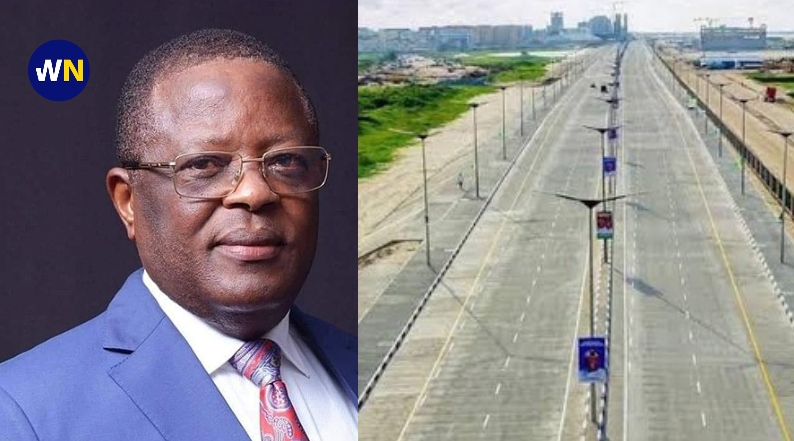
The Federal Government’s Lagos–Calabar Coastal Highway has begun attracting significant international investor interest, with at least four foreign companies offering to refund the full cost of Section One of the project in exchange for operating and tolling the road, the Minister of Works, David Umahi, disclosed on Wednesday.
Speaking at a press briefing at the Ministry of Works headquarters in Abuja, Umahi said the coastal highway was deliberately designed as an investment-led infrastructure project rather than a traditional government-funded public works programme. According to him, the project aligns with the administration’s strategy of leveraging external capital to stimulate economic growth during periods of fiscal pressure.
The Lagos–Calabar Coastal Highway is a proposed major transportation corridor running along Nigeria’s coastline, intended to connect Lagos State in the southwest to Calabar in Cross River State in the south-south. A highway is a major public road designed for high-speed vehicular traffic, while a coastal highway specifically follows or runs close to a nation’s coastline, often serving both economic and tourism purposes.
Umahi explained that the Federal Government is currently funding only about 30 per cent of the project’s total cost, while the remaining 70 per cent is being sourced from international financiers. International financiers are foreign financial institutions, development banks, or investment firms that provide funding for large-scale projects across national borders. He described the expected return on investment, which refers to the financial gains relative to the amount invested, as “very high.”
According to the minister, four companies have formally indicated interest in reimbursing the government for 100 per cent of what has already been spent on Section One of the coastal highway. Section One refers to the initial segment of the highway currently under construction. In return, the interested firms would take over operations and introduce tolling. Tolling is the practice of charging road users a fee for using a specific roadway, typically to recover construction and maintenance costs.
“That process is ongoing,” Umahi said, adding that the strong investor response reflects growing confidence in Nigeria’s infrastructure framework under the current administration.
He described the Lagos–Calabar Coastal Highway as a strategic economic corridor, a term used to describe a transport route that stimulates economic activities by connecting industrial zones, ports, trade hubs, and other infrastructure. According to him, the project is designed to unlock multiple ongoing developments across the country and integrate them into a single economic network.
“This legacy project is an investment. It is linking all the ongoing projects of Mr President,” the minister said. A legacy project refers to a long-term infrastructure initiative intended to deliver enduring economic and social benefits beyond the tenure of a particular government.
Umahi also addressed criticisms raised by Senator Eyinnaya Abaribe, who had questioned the procurement process used for the project. Procurement is the formal process through which government contracts are planned, advertised, evaluated, and awarded. The minister described the allegations as a direct attack on his integrity, which refers to adherence to moral and ethical principles.
“By saying that I didn’t care about the procurement process, that is an attack on my personality and integrity,” Umahi said, adding that he expected the statement to be withdrawn.
He maintained that the project fully complied with the Public Procurement Act, which is Nigeria’s primary law regulating how public funds are spent on goods, services, and works. The Act recognises three procurement methods, meaning legally approved procedures through which contracts can be awarded. Umahi said all applicable methods were duly observed in the execution of the Lagos – Calabar Coastal Highway.
“I want him to go and study the Procurement Act and come back to tell Nigerians whether there was any infringement in the procurement of the Lagos – Calabar Coastal Highway,” he said. An infringement, in this context, refers to any violation of legal or regulatory provisions.
The minister further explained that the project underwent a comprehensive Environmental and Social Impact Assessment, commonly referred to as ESIA. An ESIA is a formal process used to evaluate the potential environmental and social effects of a major project before construction begins. It is often required by law and by international lenders as a condition for financing.
According to Umahi, the ESIA process for the coastal highway involved public advertisements to inform affected communities, stakeholder engagements with residents and interest groups along the project route, and independent assessments led by an academic expert. Stakeholders are individuals or groups with a direct or indirect interest in a project, while independent assessments are evaluations conducted by parties not directly involved in the project’s execution to ensure objectivity.
He said the process also included an open international comment window, which allows global experts and institutions to review and provide feedback on the project before certification. Certification, in this context, refers to the official approval issued after all ESIA requirements have been satisfied.
“At the end of the day, a certificate of ESIA was issued. It was displayed publicly, and it remains on record,” the minister said.
Umahi disclosed that international financiers, including the Dutch Development Bank, carried out their own independent evaluations of Section One of the project. A development bank is a financial institution that provides long-term funding for projects that promote economic development. According to him, these evaluations returned favourable verdicts, meaning positive conclusions about the project’s viability and structure.
“They found that the project was properly packaged, of very high quality, and undervalued,” Umahi said. In this context, undervalued means that the project’s long-term economic benefits exceed its current estimated cost.
He added that when the project was opened to foreign financial institutions, it was oversubscribed by $100 million. Oversubscription occurs when the amount of funding offered by investors exceeds the amount requested, often indicating strong investor confidence.
According to the minister, the oversubscription underscores global confidence in the credibility of the Lagos–Calabar Coastal Highway project. Credibility refers to the trustworthiness and reliability of a project in the eyes of investors and stakeholders.
“International funders are not jokers. They scrutinise every detail before approving funding,” Umahi said, emphasising that such institutions conduct rigorous due diligence, a process involving detailed financial, technical, and legal reviews before committing capital.
The Federal Government has repeatedly stated that the Lagos–Calabar Coastal Highway is central to its broader infrastructure and economic transformation agenda, with officials positioning it as a catalyst for trade, investment, and regional integration along Nigeria’s coastline.
Disclaimer: This article is for informational purposes only and does not constitute financial or investment advice. WatchNigeria is not responsible for any losses arising from reliance on the information provided. Always conduct your own research or consult a qualified professional.